Chandramohan Thunders Through ‘Geeta’, Durga Khote’s Sparkling Performance !
Subscribe to read full article
This section is for paid subscribers only. Our subscription is only $37/- for one full year.
You get unlimited access to all paid section and features on the website with this subscription.
Not ready for a full subscription?
You can access this article for $2, and have it saved to your account for one year.
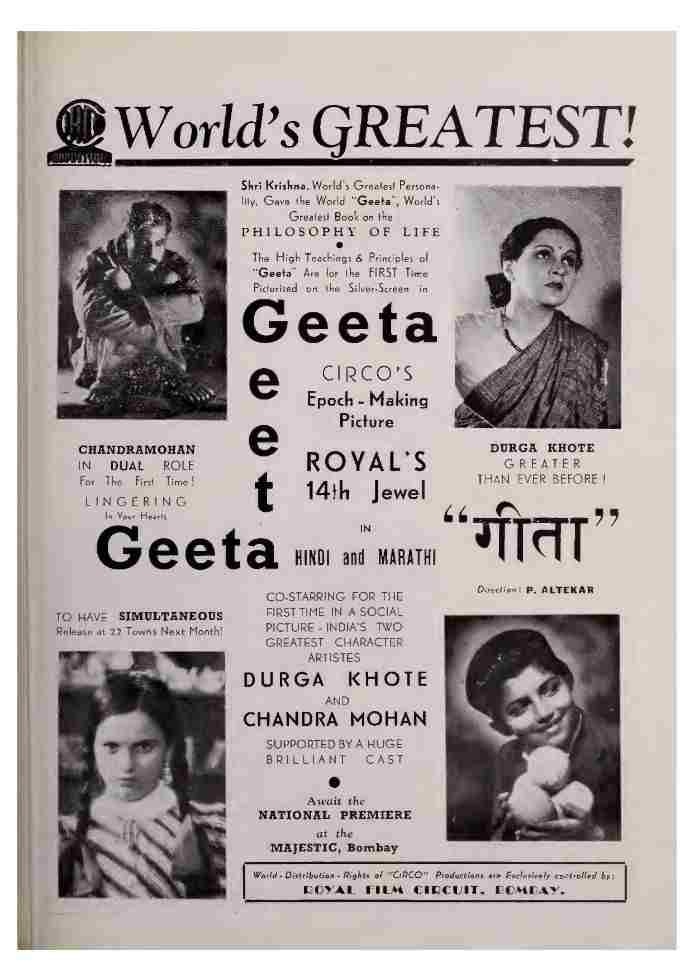
The unfortunate thing about this Circo Picture is its name Geeta (1940). It seems that the name was conceived first and the story was stretched subsequently to come up to the name. Geeta is a misleading name to this social melodrama which has a convincing pretence of a theme underlying its picturization.
In their advertisements, the producers have made a lot of the name of the picture and in doing so have misguided people into believing it to be a religious theme, thereby keeping a large section of people away from the theatre.
In addition, the vagaries indulged in giving cheap publicity to the picture has alienated the public sympathy for the picture. Moreover, the advertisements themselves have made poor and puerile copies which failed to appeal. And it is a pity to observe all this when the subject could have been correctly advertised and made a success financially.
And yet purely from the production point of view, this picture of Circo is their best production since they began producing pictures in Bombay. And that is saying a lot after the disgraceful failures of Sohag (1940) and Anuradha (1940).
A PHILOSOPHIC STORY
The story has a deeply philosophical idea underlying it. Shankar and Durga are poor and have Mohan, their child to share. Durga believes in virtuous living as enjoined by the tenets of the Bhagwat Geeta. She leads a devotional life. But Shanker, a practical man, vindictive because of the ungrateful apathy of the world, finds only frustration in his wife’s devotional pursuits. Burning his boats behind he becomes an outcast and leaves the home with his little son Mohan.
Shanker is now on the highways of life, seeking a living and shelter by his wits. He becomes an expert crook and makes his son also an efficient understudy. The arrogance of success in his sharp practices, he considers as his strength to be pitted against the world.
Durga on the other hand pursues her course of the virtuous life in the midst of usual difficulties and gets another son Kumar, whom she trains up according to her ideals.
In the city, Shanker and Mohan are feared as dangerous characters and they seem to be doing well for a time, in the midst of loot and killings. Then one day, Shanker is caught for murder and hanged. Mohan decides to wreak a dire vengeance on the people who plotted against his father. He follows faithfully in his father’s footsteps and heaps killings on killings. And then Mohan also faces the law for murder. But as fate would have it, his own younger brother, now a barrister, prosecutes the charge against him.
Under the most dramatic circumstances, Mohan and his mother meet again. And the tears of faith, which the virtuous woman sheds, melts the scoundrel’s heart which immediately becomes thirsty for salvation.
To the superficial observer, Geeta looks like a crime drama, because a gangster runs riot through it. But, perhaps accidentally, the punishment of crime is so often stressed and the need to live a better life is so often preached that the crime part looks incidental to the person who would stop and think a bit.
The production values are poor all round. The direction is weak. The photography is mediocre. The sound recording is bad. The music is hopeless, both in the choice of tunes and the singing, barring one song of Vatsala Kumptekar. Utterly stupid editing has made the picture boring at places. With a little clever and imaginative re-editing the picture will improve a lot.
INIMITABLE CHANDRAMOHAN
And now Chandramohan! Irresistible, inimitable and incomparable as usual, thunders through the picture like a giant, radiating a thousand reflections of his personality in a three-in-one portrayal and making Geeta a picture to be seen.
The man acts in his words. His very voice thrills with its well-measured modulations tuned to the subtleties of the different situations. His relentless cruel eye searching for a prey, when it descends on his little son, melts dotingly with the love of a universe in it. Marvellous! In that one tilt from the victim to his son, is a complete romance of histrionics which only Chandramohan can interpret. Bravo! Chandramohan.
Durga Khote takes a lot of the screen with scenes that sharply contrast with crime. Perhaps the extreme contrast itself makes her scenes a little boring. The only temptation to go through them is Durga’s superb and sincere work. In her scenes with Chandramohan, she keeps up well though matched with a dynamic artiste. It must, however, be remembered that in case of Chandramohan and Durga Khote, the director is hardly necessary for their performances. They don’t need a director.
Anant Marathe, that darling little fellow, must be mentioned with these big names. He is the only one who keeps good company with a confidence that suggests experience and courage.
The rest of the performances were just trash. None of the others knew what they were about.
Well, Geeta should be seen, if only to see Chandramohan or Chandramohan and Durga Khote for the first time together.
This review was originally published in Film India in the November 1940 issue.
About the Author

Other Articles by Cinemaazi
Kurosawa the Versatile
Yesterday Tomorrow - Nargis
Britain and the Documentary Film - Marie Seton
Body and Soul of Music
Unforgettable Moments -Nalini Jaywant
Shahenshah (1988) - Preview
रेश्मी सलवार कुरता जाली का : O P Nayyar
Patang (1960) - Picture Preview
All My Christmases- Mala Sinha
हमें तो विछड़ना ही था...Shailendra
Lalita Lajmi on Guru Dutt: Unfinished Symphony
Guru Dutt: The "Typical Hero" Tag Doesn't Fit
Film in Retrospect: Images Images
Hamlet of Films - Guru Dutt
Khuda, Maut aur Ghulam... Guru Dutt
नई शैली निराला संगीत - R D Burman
आर्यसमाजी अध्यापक का बेटा, मैं... Dharmendra
What is a Good Documentary Film?
Salute to an Immortal Spirit
A Painful Parting
Children's Film Society
Let's Give the Kids a Chance
Directing the Child Actor
Chandu - The Elephant Boy
HEROISM-Children's Film Society gives the lead
Munna
ख्वाजा अहमद अब्बास का पत्र महात्मा गांधी के नाम
Shakti Kapoor: It's Three Punches A Day
Should a Filmmaker be Original?
Babita My First Screen Love
Phir Wohi Dil Laya Hoon
Romance in Our Cinema
The Romance of our Show Houses
Kashmir Ki Kali (1964)
Sangam (1964)
This thing called Love
Gandhi: Whose voice?
"Deewar" Becomes a Nation's Prayer
Mangal Pandey
History of Cinema, History of the Nation
Birbal Paristan Mein
Reincarnation... the story goes on ever after
The Film Director?
M Sadiq
The Social Role of the Cinema
"Samaj" A Memorable Film with Popular Appeal
"Two Eyes" in Hollywood
Do Dooni Chaar
Rafoo Chakkar
Johnny Walker.... still going strong
Mahabharat : Epic Tamasha
Narsi Bhagat : An Excellent Biography
Nav Ratri
एक ताजगी का नाम है देवानन्द (Dev Anand)
जे बी एच वाडिया (J B H Wadia) - वचन न जाए
Children's Films in India
Horses .... Cars and Laughs-Mehmood
हिन्दी फिल्मों की दुर्दशा का जिम्मेदार कौन?
क्या हिंदी फिल्मों से हास्य गायब हो रहा है?
हास्य की परंपरा और हास्य अभिनेताओं की भूमिका
प्राण (Pran) और उनकी दाढ़ियाँ
Odds Against a New Comer
Speaking of Portraits and People
An Actor Prepares
Producers' War on Dubbed Films
Jottings from a Film Director's Notebook
प्रेमचंद सत्यजीत राय और ’सद्गति’ -गिरिजाशंकर
Rewind 1990 Commerce of Love Stories
Eastern Scene: Cinema of Surviving Faith
Movie Memories : Tansen (1943)
Movie Memories: Sikandar (1941)
Towards A Brighter Future- Bengali Cinema
The Enigma Of A Flux - Malayalam Cinema
The seesaw graph of Hindi filmdom
Ankahee: The Unspoken
The Mahatma Returns: World Press Reaction
Children’s Films
Telugu Cinema in 1986- Sons and Fathers
Mukhamukham : Face to Face
Tarang : Wages and Profits
Design In Indian Cinema
Movie Memories : Savkari Pash
Double Trouble: Role of Twins In Hindi Cinema
Prem Chopra: The Same Role For Ever
Kalyan Kumar - Karnataka’s Self-Made Star
Ceylon's Cyclonic Cinema
Movie Memories : Aladdin & the Wonderful Lamp
Kumari Padmini: Rising New Star Of The South
50 YEARS OF MALAYALAM CINEMA
Alakh Niranjan: Film India Review
Party: The Story of Choices
The Naushad Era In Hindi Film Music
A Man: Amitabh Bachchan -Amitabh, is My Name
A Man: Amitabh Bachchan - Two of a Kind
Women In Hindi Films : Dichotomy of Values
A Man: Amitabh Bachchan - Yesterday and Tomorrow
Cinema in the South: Crisis of Character
Film Societies Play Their Part
Nutan : A Flashback - The Actress
"Gwalan" Proves A Thrilling Entertainment !
Rajesh Khanna : Echoes Of An Era- Family Of Four
Holi: A Metaphor for Horizontal Violence
A Summon for Mohan Joshi
Nutan : A Flashback - The Friend
Raj Kapoor Scores Personal Triumph In “Aag”!
Smita Patil's Memoir- Trading Places
Shashi Kapoor: Once Upon A Time- The Film Makers
Rajesh Khanna : Echoes Of An Era- Peer Pressures
“Lal Haveli”- Crude But Entertaining!
Nutan : A Flashback - The Wife
Rajesh Khanna : Echoes Of An Era
"Lalkar" Presents Cheap Entertainment
Smita Patil's Memoir-Comrades In Arms
Shashi Kapoor: Once Upon A Time- Unjinxed
Ek Din Ka Sultan- Becomes Good Entertainer !
Smita Patil's Memoir- Friendly Strokes
Shashi Kapoor: Once Upon A Time- Tough Times
The Technician And His Problems
We Must Inject Dynamism Into Publicity
The Role Of Film Finance Corporation
Progress In Raw Film
Freedom In Films
Export Market For Indian Films
The Growth of The Motion Picture
Setup Of The Film Industry
Few Facts About Film Production
Personalisation In Cinema
Waiting for a Doyen's Glance- Arati Bhattacharya
कौन सुनेगा इन सिसकती बिलखती प्रतिभाओं का विलाप?
Asrani - Laugh And The World Laughs With You
My Memorable Roles- Hiralal
राजीव गोस्वामी - कहां थे अब तक 'पेंटर बाबू'?
जब नफरत से बेड़ा पार हो गया: बलराज साहनी
The Case of Emotional Turmoil In Dopatta (1952)
The Story Of A Child Artiste - Sheela Kashimiri
Afsana Likh Rahi Hoon : Tun Tun
Some Hopes For The New Year: Lillian
Joru Ka Bhai: A Tale of 'Atithi Tum Kab Jaoge'
अभिनेता प्रेमअदीब से भेंट
Vijaylaxmi: A Career As The 'Other' Woman
Shaminder: The Actor Who Had High Hopes
धर्मेन्द्र - समय आ रहा है...
Film Life After Fifty : Motilal
प्रसिद्ध फिल्म लेखक गुलशन नंदा से आपकी बातचीत
"I live on hope"- Kumkum
Thehr Zara O Jane Wale : Madhubala Jhaveri
Ratnamala Attracts Attention In ‘Station Master’
Ghory: The Laurel Of Indian Cinema's Comedy Duo
Yeh Teri Saadgi, Yeh Tera Baankpan: Usha Khanna
सेनापति शेट्टी
कृतिदेव यहां मैं, तनूजा, स्वीकार करती हूँ
मै उर्मिला को भूल नहीं पाती - मंजरी
बुलबुल बंगाल की: चंद्राणी मुखर्जी
Payyal's Lucky Break
These Foreign Producers
The Practical Actress: Shabnam
“Amrit” Becomes A First Class Picture
फिल्मी मारपीट के गुरू : अजीम भाई
From Poverty to Screen Fame - Mehboob Khan
Humility: Nasreen's Most Admirable Feature
A Mercenary Comes To India - Bob Christo
Dilip Kumar: The Leader
Alam Ara: Ardeshir Irani's Ambitious Secret
I Serve My Art- Kanan Devi
Pran: The Pillar of Hindi Cinema
.jpg)


social media

Released in 1986, Jaanbaaz remains one of the most stylish and ambitious films of 1980s Hindi cinema. Produced and directed by Feroz Khan, the film blended family drama, romance, action, and crime within a visually lavis...
View on Facebook
Mumtaz Shanti remains one of the most luminous stars of 1940s Indian cinema and is often remembered as Hindi cinema’s first true female superstar. Celebrating her birth centenary is an occasion to revisit the extraordina...
View on Facebook
See posts, photos and more on Facebook.
View on Facebook