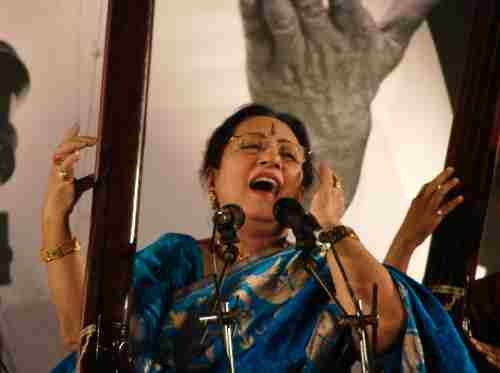
Body and Soul of Music
05 May, 2026 | Archival Reproductions by Cinemaazi
Subscribe to read full article
This section is for paid subscribers only. Our subscription is only $37/- for one full year.
You get unlimited access to all paid section and features on the website with this subscription.
Not ready for a full subscription?
You can access this article for $2, and have it saved to your account for one year.
Body and soul, it is said, are the two sides of a coin. The human being is not complete without both.
The almost uniformly parochial thinking which exists in many quarters today regarding classical and light music amuses me for this very reason, and the tirade against light music reminds me" of the similar position in which "modern" painting found itself at the turn of the century.
"There is no difference between classical and light music," says the author in his forthright article.
So I want to say, with the greatest possible emphasis, that there is no difference between classical and light music. The relationship between the two is like that of the moon and the light which it sheds. Or to revert to our original simile, that of body and soul.
The greatness of classical music is undisputed. It requires none to champion its cause. We are all aware of its fascinating range, flexibility, sweetness and power. We bow our heads before it. It has been tested on the anvil of time and not found wanting. But what about light music? How did it come about, and are not its claims to reconciliation valid?
The origin, structure and significance of both classical and light music must be understood in terms of the times in which they flourish. Let us examine the world of music seventy or eighty years ago.
Conditions were very different then. There was peace, and the tempo of life was not as high-pitched as it is today. There was leisure to savour the pleasures which the arts provided. Classical music, with its ''spread out" measures and prolonged strains, was the natural product of the times.
... songs have spread the message of universality, of the oneness of man's body and soul, the oneness of all mankind.
"When Indian classical music got lost in its own unending convolutions, when Technique developed at the cost of the Spirit, music withered and died. Under the weight of the "taan" and the "palta", the heart of music was broken," says music director Ramchandra.
If a classical "raga" was lengthened by innumerable variations and sung over and over again from evening into the early hours of the morning, it was because people had the time and inclination to sit, listen and appreciate.
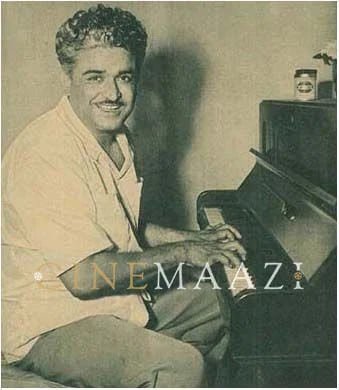
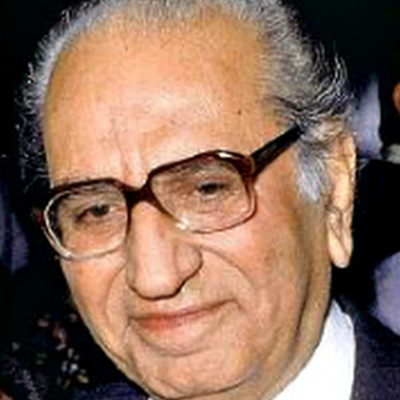
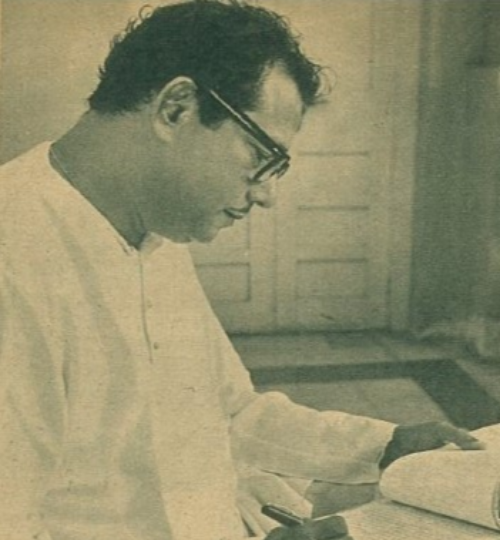
C Ramchandra is seen here trying out one of his new compositions on the piano.
Life today, however, is very different. The tempo has quickened unbearably, and the struggle for existence in a world of turmoi1 leaves hardly any time for one to relax. People are restless. Our way of life and thinking, too, have been attuned to the fast pace of our times.
People no more have time to sit through the night in a state of emotional exaltation swaying and nodding to the refinements of the classical ragas. They have to be at the office by 9-30 a.m. or earlier!
So, people want to be entertained in the quickest possible way and the shortest possible time. The pleasure once derived in an hour's listening to music must now be taken in three minutes-the equivalent of the time it takes to play one side of a gramophone record.
Art, to be dynamic and survive, must continually undergo changes and, in doing so, must adapt itself to changing conditions of life. So, too, music must continually grow with the times and adapt itself.
Music is a treasure which belongs to the people. In what form and manner it is to be presented to them is their business, not that of the pedants and critics. And it is we musicians who are responsible for presenting it in the desired manner and form.
The time has therefore come to approach the problem with understanding. It calls for broadmindedness, too. I cannot help remembering the great Saigal, a fine classical singer who brought glory to film music. Despite the classical style of his singing, his songs are still on the lips of people throughout the country. This, I think, is the greatest tribute which can be paid to light music.
What is light music-a "geet," for instance? It is a manifestation of the emotions which spring up in us, feelings which spring not from the mind but from the heart.
Thousands of such "geets" are composed every year, but only a few of them become popular. Why? Several factors are responsible. In some, the lyrics are poorly composed. Fine emotional feelings are lost by clumsy expression.
Yet, I feel, by and large the reason why some "geets" fail to appeal is that there is nothing unusual about them. The ability to set lyrics to unusual, effective melodies comes from the music-director. And it is melody which is the life-blood of the light song.
Since the tempo of life today is so swift, it is not easy to interrupt it and make people stop, listen and appreciate. So the music director has to employ all the artifice, all the musical magic at his command, and come up with a tune which can make them stop, listen and enjoy.
The lyric must be composed with imagination. The words should be simple, easily understood and should put the meaning across poetically. It otherwise is lifeless. Then it should be "tuned" to be in keeping with its mood, emotions and the feelings it expresses. The tune should be unusual and arresting. It should bring out the soul of the lyric.
A good melody is one which sounds new to the ear. It should sound unusual, yet should be easy to remember, easy to sing.
Various techniques are in favour among music directors in achieving certain effects in light music. They should, however, always aim at freshness in melody, a quick, easy rhythm and a glossy finish.
A glossy finish is absolutely necessary. It is the very life of the song. If the song is crude and "unfinished," it will sound so to the listener and never become popular.
We have, during the years, assimilated much from the music of foreign countries. There is nothing wrong in that. On the contrary, it is desirable to put before our people the good features of foreign music and to adapt the beautiful in it, in our own manner, to our own needs, and to blend it into our own music.
Music is of the people. In every country it is of the people-not of the chosen few. If new experiments are being made in music in other parts of the world, why shouldn't our music benefit from them?
I believe in the adaptation of Indian classical music as well as foreign music to the growing needs of the Indian film song. The orchestration in the music of the West is so perfect that we can learn much from it.
I know that thousands of Indian music records are sold abroad. The musicians of other lands commend the style and technique of our film music, and sometimes even adapt our music.
Probably, no other country in the world has music so much in its blood as we have. We must try to understand the needs of our people, their emotions and their aspirations, and give them music which satisfies them. They want music which plucks at the heart-strings. Let us give it to them.
When Indian classical music got lost in its own unending convolutions, when technique developed at the cost of the spirit, music withered and died. Under the weight of the "taan" and the "palta" the heart of music was broken. Thus our classical music wandered off the path. It was lost in the by-lanes of technique, in endless display of the mechanics of music.
And so the common man gradually became indifferent to such music. In his search for a music with which he could identify himself, he turned to something more vital, more living. The songs of the soil sounded in his ears- the simple, earthy chants of village girls drawing water at the well, their lilts in rhythm with their movements-folk songs, simple, touching and as elemental as blood, love, laughter and tears. In other words, a living music.
And so the classical "baithaks" dwindled and the gatherings of people at the temples, at the wells, in the fields and by the fireside increased. Music grew young again. It could again take people on the wings of fancy, flying them through realms far above.
The magic of the "geet" is the magic of the senses, the magic of the body. In the bhajan lies the magic of the soul. The world of the bhajan is a strange world. It has revelations and pleasures unequalled. Out of the strong rhythms of the "mradang," and the brass cymbals and drums, divine ecstasy is evoked in which people lose themselves.
There are as many forms of bhajan as there are provinces in India. There are the keertans of Bengal, the bhajans of Maharashtra, of Gujerat, of Kathiawar, of the Punjab, the South and Uttar Pradesh. Each has its own form and, in spite of being written in different languages, the impact of all these bhajans is the same.
I mention the bhajan here because it is sung by, and for, large groups of people. This has brought people in close touch with music and made them music-minded.
I would go to the extent of saying that it is the bhajan which has spread music to all parts of India, and popularised it among people everywhere.
It springs from the earth, from the heart of man. It speaks to the soul. It has been composed and sung by Tulsidas, Meera, Sur, Kabir. Nanak, Tukaram, Namdev, Chandidas, Narsi Mehta- poet-saints in different parts of the country. Their songs have spread the message of universality, of the oneness of man's body and soul, the oneness of all mankind.
The bhajan has transcended all artificial barriers in music and, with its simple and direct appeal, reached out to the hearts of the common people.
In a way that is also what the light music of today has achieved.
This article was published in 'Filmfare' magazine's 20 July 1956 edition. written by C Ramchandra.
The images and captions are from the original article.
About the Author

Other Articles by Cinemaazi
07 Jul,2026
A History of the Indian Film - B D Garga
23 Jun,2026
कल ऐक्सट्रा था आज हीरो हूँ - Sanjeev Kumar
16 Jun,2026
Movie Stars-Leaders of Fashion
08 Jun,2026
Kurosawa the Versatile
02 Jun,2026
Yesterday Tomorrow - Nargis
12 May,2026
Britain and the Documentary Film - Marie Seton
17 Feb,2026
Unforgettable Moments -Nalini Jaywant
17 Jan,2026
Shahenshah (1988) - Preview
16 Jan,2026
रेश्मी सलवार कुरता जाली का : O P Nayyar
14 Jan,2026
Patang (1960) - Picture Preview
20 Dec,2025
All My Christmases- Mala Sinha
29 Aug,2025
हमें तो विछड़ना ही था...Shailendra
23 Jul,2025
Lalita Lajmi on Guru Dutt: Unfinished Symphony
17 Jul,2025
Guru Dutt: The "Typical Hero" Tag Doesn't Fit
11 Jul,2025
Film in Retrospect: Images Images
08 Jul,2025
Hamlet of Films - Guru Dutt
05 Jul,2025
Khuda, Maut aur Ghulam... Guru Dutt
25 Jun,2025
नई शैली निराला संगीत - R D Burman
25 May,2025
आर्यसमाजी अध्यापक का बेटा, मैं... Dharmendra
17 Feb,2024
What is a Good Documentary Film?
25 Jan,2024
Salute to an Immortal Spirit
22 Jan,2024
A Painful Parting
29 Nov,2023
Children's Film Society
28 Oct,2023
Let's Give the Kids a Chance
26 Oct,2023
Directing the Child Actor
25 Oct,2023
Chandu - The Elephant Boy
23 Oct,2023
HEROISM-Children's Film Society gives the lead
18 Oct,2023
Munna
29 Sep,2023
ख्वाजा अहमद अब्बास का पत्र महात्मा गांधी के नाम
02 Sep,2023
Shakti Kapoor: It's Three Punches A Day
04 Jul,2023
Should a Filmmaker be Original?
24 Jun,2023
Babita My First Screen Love
22 Jun,2023
Phir Wohi Dil Laya Hoon
19 Jun,2023
Romance in Our Cinema
12 Jun,2023
The Romance of our Show Houses
12 Jun,2023
Kashmir Ki Kali (1964)
07 Jun,2023
Sangam (1964)
05 Jun,2023
This thing called Love
25 May,2023
Gandhi: Whose voice?
15 May,2023
"Deewar" Becomes a Nation's Prayer
15 May,2023
Mangal Pandey
06 May,2023
History of Cinema, History of the Nation
02 May,2023
Birbal Paristan Mein
20 Apr,2023
Reincarnation... the story goes on ever after
27 Mar,2023
The Film Director?
21 Mar,2023
M Sadiq
15 Mar,2023
The Social Role of the Cinema
15 Mar,2023
"Samaj" A Memorable Film with Popular Appeal
01 Mar,2023
"Two Eyes" in Hollywood
20 Feb,2023
Do Dooni Chaar
15 Feb,2023
Rafoo Chakkar
07 Feb,2023
Johnny Walker.... still going strong
20 Jan,2023
Mahabharat : Epic Tamasha
10 Jan,2023
Narsi Bhagat : An Excellent Biography
03 Jan,2023
Nav Ratri
01 Dec,2022
एक ताजगी का नाम है देवानन्द (Dev Anand)
25 Nov,2022
जे बी एच वाडिया (J B H Wadia) - वचन न जाए
14 Nov,2022
Children's Films in India
01 Sep,2022
Horses .... Cars and Laughs-Mehmood
06 Aug,2022
हिन्दी फिल्मों की दुर्दशा का जिम्मेदार कौन?
01 Aug,2022
क्या हिंदी फिल्मों से हास्य गायब हो रहा है?
20 Jul,2022
हास्य की परंपरा और हास्य अभिनेताओं की भूमिका
12 Jul,2022
प्राण (Pran) और उनकी दाढ़ियाँ
17 Feb,2022
Odds Against a New Comer
10 Dec,2021
Speaking of Portraits and People
03 Nov,2021
An Actor Prepares
19 Oct,2021
Producers' War on Dubbed Films
24 Aug,2021
Jottings from a Film Director's Notebook
26 Jul,2021
प्रेमचंद सत्यजीत राय और ’सद्गति’ -गिरिजाशंकर
22 Jul,2021
Rewind 1990 Commerce of Love Stories
20 Jul,2021
Eastern Scene: Cinema of Surviving Faith
22 Jun,2021
Movie Memories : Tansen (1943)
22 Jun,2021
Movie Memories: Sikandar (1941)
15 Jun,2021
Towards A Brighter Future- Bengali Cinema
20 May,2021
The Enigma Of A Flux - Malayalam Cinema
05 May,2021
The seesaw graph of Hindi filmdom
03 May,2021
Ankahee: The Unspoken
29 Apr,2021
The Mahatma Returns: World Press Reaction
29 Apr,2021
Children’s Films
17 Apr,2021
Telugu Cinema in 1986- Sons and Fathers
09 Apr,2021
Mukhamukham : Face to Face
08 Apr,2021
Tarang : Wages and Profits
01 Apr,2021
Design In Indian Cinema
27 Mar,2021
Movie Memories : Savkari Pash
23 Mar,2021
Double Trouble: Role of Twins In Hindi Cinema
22 Mar,2021
Prem Chopra: The Same Role For Ever
19 Mar,2021
Kalyan Kumar - Karnataka’s Self-Made Star
18 Mar,2021
Ceylon's Cyclonic Cinema
18 Mar,2021
Movie Memories : Aladdin & the Wonderful Lamp
17 Mar,2021
Kumari Padmini: Rising New Star Of The South
11 Mar,2021
50 YEARS OF MALAYALAM CINEMA
02 Mar,2021
Alakh Niranjan: Film India Review
27 Feb,2021
Party: The Story of Choices
26 Feb,2021
The Naushad Era In Hindi Film Music
19 Feb,2021
A Man: Amitabh Bachchan -Amitabh, is My Name
10 Feb,2021
A Man: Amitabh Bachchan - Two of a Kind
29 Jan,2021
Women In Hindi Films : Dichotomy of Values
22 Jan,2021
A Man: Amitabh Bachchan - Yesterday and Tomorrow
22 Jan,2021
Cinema in the South: Crisis of Character
18 Jan,2021
Film Societies Play Their Part
01 Jan,2021
Nutan : A Flashback - The Actress
30 Dec,2020
"Gwalan" Proves A Thrilling Entertainment !
29 Dec,2020
Rajesh Khanna : Echoes Of An Era- Family Of Four
28 Dec,2020
Holi: A Metaphor for Horizontal Violence
23 Dec,2020
A Summon for Mohan Joshi
22 Dec,2020
Nutan : A Flashback - The Friend
22 Dec,2020
Raj Kapoor Scores Personal Triumph In “Aag”!
19 Dec,2020
Smita Patil's Memoir- Trading Places
17 Dec,2020
Shashi Kapoor: Once Upon A Time- The Film Makers
16 Dec,2020
Rajesh Khanna : Echoes Of An Era- Peer Pressures
15 Dec,2020
“Lal Haveli”- Crude But Entertaining!
12 Dec,2020
Nutan : A Flashback - The Wife
10 Dec,2020
Rajesh Khanna : Echoes Of An Era
09 Dec,2020
"Lalkar" Presents Cheap Entertainment
07 Dec,2020
Smita Patil's Memoir-Comrades In Arms
01 Dec,2020
Shashi Kapoor: Once Upon A Time- Unjinxed
28 Nov,2020
Ek Din Ka Sultan- Becomes Good Entertainer !
26 Nov,2020
Smita Patil's Memoir- Friendly Strokes
25 Nov,2020
Shashi Kapoor: Once Upon A Time- Tough Times
07 Nov,2020
The Technician And His Problems
06 Nov,2020
We Must Inject Dynamism Into Publicity
05 Nov,2020
The Role Of Film Finance Corporation
04 Nov,2020
Progress In Raw Film
30 Oct,2020
Freedom In Films
28 Oct,2020
Export Market For Indian Films
23 Oct,2020
The Growth of The Motion Picture
22 Oct,2020
Setup Of The Film Industry
21 Oct,2020
Few Facts About Film Production
13 Oct,2020
Personalisation In Cinema
08 Oct,2020
Waiting for a Doyen's Glance- Arati Bhattacharya
08 Oct,2020
कौन सुनेगा इन सिसकती बिलखती प्रतिभाओं का विलाप?
06 Oct,2020
Asrani - Laugh And The World Laughs With You
05 Oct,2020
My Memorable Roles- Hiralal
03 Oct,2020
राजीव गोस्वामी - कहां थे अब तक 'पेंटर बाबू'?
03 Oct,2020
जब नफरत से बेड़ा पार हो गया: बलराज साहनी
30 Sep,2020
The Case of Emotional Turmoil In Dopatta (1952)
29 Sep,2020
The Story Of A Child Artiste - Sheela Kashimiri
26 Sep,2020
Afsana Likh Rahi Hoon : Tun Tun
26 Sep,2020
Some Hopes For The New Year: Lillian
24 Sep,2020
Joru Ka Bhai: A Tale of 'Atithi Tum Kab Jaoge'
22 Sep,2020
अभिनेता प्रेमअदीब से भेंट
21 Sep,2020
Vijaylaxmi: A Career As The 'Other' Woman
18 Sep,2020
Shaminder: The Actor Who Had High Hopes
16 Sep,2020
धर्मेन्द्र - समय आ रहा है...
14 Sep,2020
Film Life After Fifty : Motilal
14 Sep,2020
प्रसिद्ध फिल्म लेखक गुलशन नंदा से आपकी बातचीत
11 Sep,2020
"I live on hope"- Kumkum
11 Sep,2020
Thehr Zara O Jane Wale : Madhubala Jhaveri
09 Sep,2020
Ratnamala Attracts Attention In ‘Station Master’
08 Sep,2020
Ghory: The Laurel Of Indian Cinema's Comedy Duo
07 Sep,2020
Yeh Teri Saadgi, Yeh Tera Baankpan: Usha Khanna
07 Sep,2020
सेनापति शेट्टी
05 Sep,2020
कृतिदेव यहां मैं, तनूजा, स्वीकार करती हूँ
05 Sep,2020
मै उर्मिला को भूल नहीं पाती - मंजरी
04 Sep,2020
बुलबुल बंगाल की: चंद्राणी मुखर्जी
03 Sep,2020
Payyal's Lucky Break
02 Sep,2020
These Foreign Producers
29 Aug,2020
The Practical Actress: Shabnam
29 Aug,2020
“Amrit” Becomes A First Class Picture
28 Aug,2020
फिल्मी मारपीट के गुरू : अजीम भाई
26 Aug,2020
From Poverty to Screen Fame - Mehboob Khan
26 Aug,2020
Humility: Nasreen's Most Admirable Feature
24 Aug,2020
A Mercenary Comes To India - Bob Christo
23 Aug,2020
Dilip Kumar: The Leader
19 Aug,2020
Alam Ara: Ardeshir Irani's Ambitious Secret
17 Aug,2020
I Serve My Art- Kanan Devi
10 Jul,2020
.jpg)