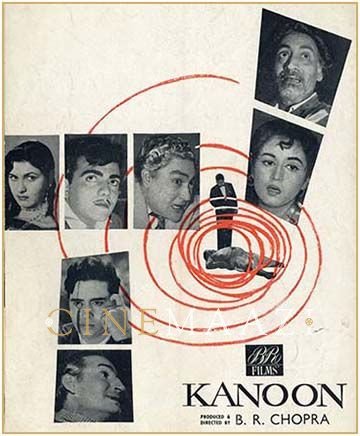
Booklet cover of "Kanoon" (1960) from Cinemaazi archive
Subscribe to read full article
This section is for paid subscribers only. Our subscription is only $37/- for one full year. You get unlimited access to all paid section and features on the website with this subscription.
There is a scene that has played out in hundreds of Hindi films across nearly seven decades. A courtroom which is tense and hushed where the judge adjusts his spectacles, surveys the accused, and pronounces,
“Dafa 302 ke tahat, tamam sabuton ko madhe nazar rakhte hue, muzrim ko saza-e-maut di jaati hai.” He then snaps the nib of his pen a gesture nowhere mandated by the Code of Criminal Procedure.
Somewhere in a darkened hall across the country, an audience exhales. Justice, at last, has been done. This court room scene did something beyond entertainment and redemption. It told generations of Indians many of whom had never set foot inside a real courtroom that murder had a number and that number was 302 which carried within it the full, irreversible weight of the gallows. Similarly, 420 was not even a number, it was a character, a philosophy and phrases like, “tareekh pe tareekh” were less a dialogue than a notional understanding of criminal procedure code. No legal textbook could have achieved what that repeated image achieved, the inscription of statutory law into the collective emotional memory of an entire civilisation.
In July 2024, India replaced the Indian Penal Code, 1860 (IPC), the Code of Criminal Procedure (CrPC), and the Indian Evidence Act, 1872 with the Bharatiya Nyaya Sanhita (BNS), the Bharatiya Nagarik Suraksha Sanhita (BNSS), and the Bharatiya Sakshya Adhiniyam (BSA), respectively, emphatically dismantling the colonial-era architecture of criminal law. For the legal and judicial constituency, it is the setting of a new dawn. Several sections have been renumbers, definitions reframed. However, it remains to be seen how the creative writers of Hindi cinema reset the button? In a country where the ordinary people receive legal education through the screen than the statute book how will the filmmakers now tell courtroom dramas and crime stories differently?
The Nation’s Most Effective Law School
India at its core is a civilisation of storytelling. The gravest moral questions about justice, duty and transgression have historically been transmitted not through abstract treatise but in the form of narratives.
The Mahabharata, for instance, holds much more cultural and moral status than just being an epic — it is jurisprudence rendered as drama. It is therefore not surprising that, in the modern times, cinema assumed the pedagogic function that ancient storytelling traditions once held.
It also became an effective law school not using statutes or commentaries, but by telling stories of justice, crime around our legal system. Courtrooms on screen stripped away procedure and replaced it with spectacle. The admissibility of evidence, the standard of proof beyond reasonable doubt, the essential distinction between actus reus and mens rea all of these were subordinated to the demands of narrative momentum and emotional satisfaction. Yet none of this diminishes cinema’s remarkable achievement as an instrument of popular legal literacy however imperfect that could be. In fact, the dramatic monologue by a protagonist in a cinematic courtroom served as catharsis for millions of ordinary people who had been victim of the vagaries of the sluggish criminal justice system finding in the hero’s speech a vicarious reckoning.
Chaar Sau Bees: A Statute Becomes a Character
Technically, S. 420 IPC was a punitive provision for cheating and dishonestly inducing delivery of property, prescribing a maximum of seven years’ imprisonment. But the number long ago got detached from its statutory context and attached it to character, a metaphor for aspiration, simultaneously accusatory and indulgent, signalling not just fraud but a certain street-smart improvisation in the face of an unequal world. Popular anecdote holds that even the old Parliament building , the institution that enacted the very laws now replacing the IPC did not have a seat numbered 420. Whether coincidence or deliberate avoidance, this captures how thoroughly the number had embedded itself in the national psyche.
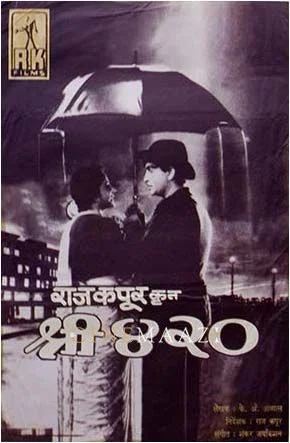
A poster of "Shree 420" (1955) from Cinemaazi archive
It was Raj Kapoor’s Shree 420 (1955) that permanently altered the number’s meaning in public imagination.
Raj, a young man arriving in Bombay from Allahabad, quickly discovers that the city runs on different rules. Drawn into manipulation and glamour, he becomes a smooth-talking confidence man yet his redemption arrives through a public act of truth-telling, exposing the real fraudster behind the respectable façade. The film closes a resonant line “Yeh 420 nahin, Shree 420 hain”, not a cheat, but a gentleman cheat. Society’s most dangerous fraudsters, Raj suggests, are those who appear the most respectable.
Subsequent films expanded this cultural vocabulary in different directions. Shrimati 420 (1956) extended the trope into gendered comedy. Ustad 420 (1969) embraced the charismatic trickster as entertainer. Chachi 420 (1997) moved the number almost entirely away from criminality, with disguise and deception becoming vehicles for affection and family. By the time Kamal Haasan put on a sari and became a nanny, “420” had completed a remarkable transformation from a penal section to a social archetype.
Now, legally speaking, "420" is gone. Under the BNS, cheating and dishonest inducement falls under S.318, while cheating by impersonation moves to S. 319. The substance of the law is largely unchanged, up to seven years of imprisonment or a fine and the restructuring is part of the broader effort to modernise and shed the colonial legacy of the IPC's numbering. But 420 is unlikely to shun the public vocabulary any time soon the cultural memory built over generations. It will be interesting to see how cinema will evolve around the new sections.
Dafa 302: When a Number Became a Verdict
Indian cinema, across its century-long journey, has held a deeply ambivalent relationship with the act of murder and Phaansi. The mention of 302 instantly communicated the gravest imaginable crime. The usage of this section in cinema entirely depends on the nature of story. Its either a dramatic device to end the film and give a finality to crime or to launch a back story so that the protagonist can begin his revenge. S. 302 is usually meant to strike an emotional chord rather than making a legal statement. The courtroom on screen where a judge is often seen pronouncing the operative part of judgment in a murder trial required no explanation, no gloss. Audiences understood it viscerally from decades of repetition of dialogues like “Milord, yeh seedha seedha 302 ka case hai!” “Ise Phaansi ki sazaa honi chahiye”, which built the understanding that the accused will be hanged till death. The audience has always understood, at some instinctive level, that the arc from murder to phaansi passes through a system riddled with corruption, class prejudice, and human fallibility. Which is in many case true but in law its not that simple. Majority of todays audiences have a pre-loaded emotional understanding that 302 meant not merely murder, but finality, irreversibility, the last word.
However, the legal architecture is more layered than the screen suggests. A conviction for murder requires both the guilty act (actus reus) and the guilty mind (mens rea). The law demands proof that the accused acted with intention, knowledge, or reckless indifference to the value of human life. The courts through its various judgments have held that the death penalty is reserved for cases that qualify as the "rarest of rare," a standard crystallised by the Supreme Court in Bachan Singh v. State of Punjab (1980), while life imprisonment remains the general rule.
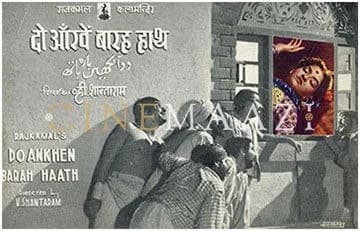
V. Shantaram’s Do Ankhen Barah Haath (1957) asked whether murderers could be reformed rather than executed a quiet but powerful argument against capital punishment made as India was still defining its post-colonial identity. B.R. Chopra’s Kanoon (1960) went further still. structurally radical, it placed a defence lawyer in the agonising position of having witnessed the very judge before him commit the murder for which an innocent man stands accused. The noose here does not represent justice it represents the terrifying fragility of a system where a wrongly placed testimony can send an innocent man to the gallows.
Booklet cover of "Do Ankhen Barah Haath" (1957) from Cinemaazi archive
Against this strand of serious engagement, the popular cinema of the Amitabh Bachchan era constructed an altogether different moral universe. In Deewar (1975), Trishul (1978), Shakti (1982) the anti-hero who kills does not die by judicial sentence but either in a shootout, or in his mother’s arms, in a manner that preserves the emotional integrity of his sacrifice. Hanging was implicitly reserved for true villains. The morally compromised hero deserved a more romantic death. This gap reveals something crucial about Hindi cinema’s moral imagination, it could not quite submit its heroes to the procedures of institutional justice, even when those heroes were guilty of the gravest crimes.
As the new law progresses will cinema continues to speak in the old tongue. Under the Bharatiya Nyaya Sanhita, murder now sits under Section 103. Section 302 of the BNS refers to something else entirely. Replacing that with “Section 103” may be a legal requirement now but for a cinema goer it lacks the same instant recall. The drama, the recognition, the cinematic punch all of that is tied to the old numbers. Over decades, repetition turned them into shorthand not just for crimes, but for emotions. A judge declaring “302” in a film is not merely citing law, it is invoking finality, punishment, even death. The courtroom scenes still echo with "IPC 302." Dialogues still invoke "tum par 302 ka case chalega" with the same dramatic weight they always carried. This is not ignorance , it is inertia.
Cinema works through recognition. It returns to what lands without explanation, to the shorthand that audiences have internalised over lifetimes. "Section 103" has not yet earned its emotional charge. That charge belongs, perhaps for another generation of audience and filmmakers.
Women, the Shifting Gaze, and the Long Arc of Section 375
Among all the legal transformations reflected in Indian cinema, none is more significant or complicated than the evolution in the portrayal of sexual violence and women dignity. For decades, popular Hindi cinema operated within an unwritten but deeply influential moral landscape that distinguished between the gharwali — the woman of the home, embodying honour and sacrifice — and the baharwali - the woman who occupied public space and was subject to scrutiny and judgement. Voyeuristic visual language like the river-bathing scene, the eve-teasing song framed as romance were tolerated and celebrated. The grammar of the male gaze and the industry that produced it gave no reason for self-examination. Sexual violence in cinematic storytelling often served as a plot device, a mechanism to establish villainy, to trigger male revenge, or to generate melodrama. The hero who was either the survivor’s lover or brother avenged her and restored honour. The woman remained the bearer of collective morality rather than an individual with agency.
The legal turning point emerged not from cinema but from a real case that shook India's feminist consciousness. In 1972, a young Adivasi girl known publicly as Mathura was raped inside a police station in custodial circumstances. The Supreme Court's judgment in Tukaram v. State of Maharashtra (1979), which acquitted the accused and drew deeply troubling inferences about consent from the absence of visible injuries and provoked a national reckoning which resulted in writing open letters from eminent jurists. It sustained public protests and feminist mobilisation compelled legislative reform. The Criminal Law (Amendment) Act, 1983 recognised custodial rape as a distinct and aggravated offence, shifted evidential burdens in custodial situations, and restricted the questioning of survivors about their prior sexual history. The law moved from "female modesty" to an understanding of sexual violence as violation of personal dignity and a failure of state.
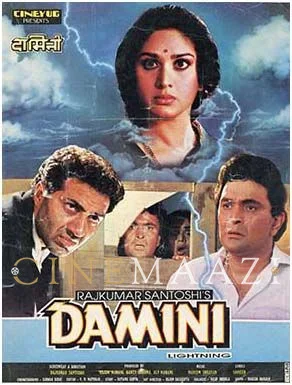
Booklet cover of "Damini" (1993) from Cinemaazi archive
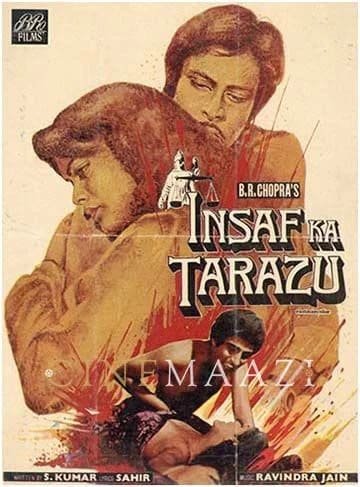
Cinema responded meaningfully though unevenly. B.R. Chopra’s Insaf Ka Tarazu (1980) allowed a victim woman to fight for herself. Damini (1993) shifted focus to the extraordinary social cost of speaking truth against one’s own family in a rape case. Pink (2016) brought consent into mainstream vocabulary with a proposition deceptively simple and politically significant - a woman’s autonomy does not depend upon her clothing, her profession, or the choices she made in the past. And Section 375 (2019) performed perhaps the most legally sophisticated act in this cinematic lineage by raising the question of consent alongside the rights of the accused a reminder that adjudicating sexual violence demands procedural rigour and not merely righteous emotion.
The Bharatiya Nyaya Sanhita now houses offences relating to women and children in a dedicated and prominently placed Chapter IV, signalling through its very structure that these are not residual concerns.
Voyeurism, once normalised by cinema as romantic entertainment, is now a cognisable and non-bailable offence.
Law alone cannot transform social attitudes. But the evolution from the staged violation of the 1960s to the consent jurisprudence of Pink demonstrates that the relationship between law and storytelling is not always adversarial. Sometimes they move together. Cinema amplifying outrage, outrage producing legal reform, reform slowly reshaping the stories cinema tells. The screen records what is, in the end, a transformation in Indian social consciousness — from the silent acceptance expected of the gharwali to the public assertion of agency by women demanding justice in their own names, before their own courts, under their own volition.
Booklet cover of "Insaf Ka Tarazu" (1980) from Cinemaazi archive
Towards a New Legal Imagination
Legal codes can be through an Act of Parliament but cultural memory moves at an entirely different pace. The old numbers will not fade quickly.
S. 420 spent nearly a century accumulating meaning, it became title of many films, the punchline of family jokes, the charge levelled at slippery politicians, the word a grandmother used when a grandchild tried to get away with something small.
In India, justice has most powerfully been seen in darkened theatres, on screens where ordinary people watched the law speak and felt, for a moment, that it spoke to them. The new criminal law architecture offers rich narrative possibilities that cinema has barely begun to explore. A legal system that promises adjudication within defined timelines.
IPC gave cinema its vocabulary. The BNS now offers cinema a new language one rooted in Indian idiom, oriented toward Indian citizens, and shaped by the hard lessons of seven decades of independent jurisprudence. Whether that intent is realised in practice will depend on courts, on enforcement, on institutional culture. But whether it enters the emotional bloodstream of the nation will depend, as it always has, on cinema. The challenge ahead is not whether Indian cinema will eventually adopt the language of the BNS but will the filmmakers make cinema under new law that can accumulate the a cultural force.
The pen has been snapped. A new nib must be found.
This article was published in 'The Bar Bulletin' on 15 June 2026.
Asha Batra is a film historian, archivist and exhibitor. The Founder Trustee of Indian Cinema Heritage Foundation, Asha also heads Cinemaazi Research Centre, the Foundation’s flagship project which is creating a research based digital encyclopaedic resource of Indian films and its people.
This section is for paid subscribers only. Our subscription is only $3700/- for one full year. You get unlimited access to all paid section and features on the website with this subscription.