
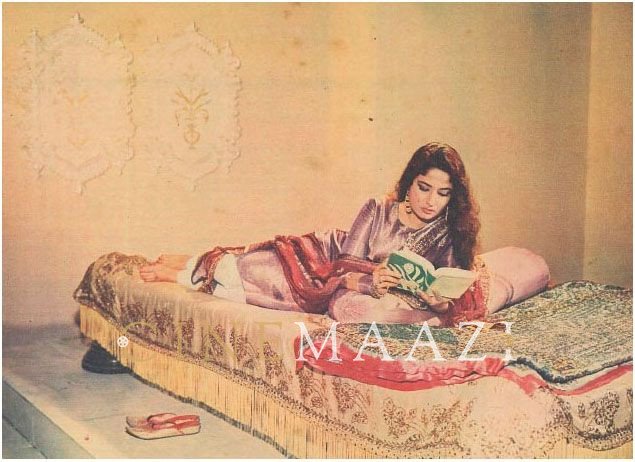
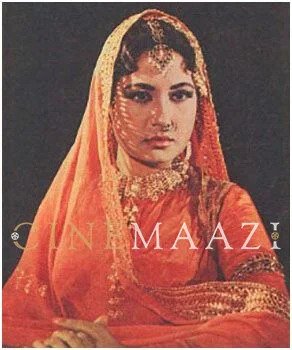
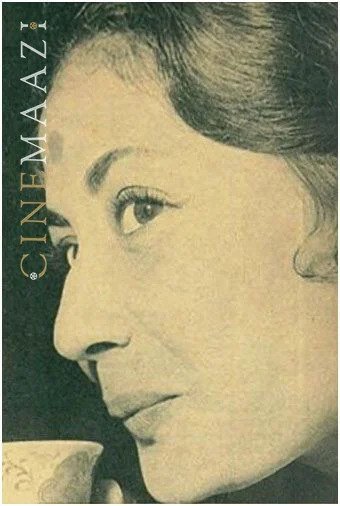
DRESSED all in white, Meena Kumari steps out of her car to attend the premiere of her picture. Her gait and her slanting eyes suggest the Orient. Her slightly-parted lips enhance the beauty of her oval-shaped face. Her legs talk.
Suddenly there is a commotion in front of the theatre entrance. Two groups of rowdies throw themselves upon each other in a free fight. Perhaps, pickpockets creating a disturbance to cloak their activities. Or rival groups of black-marketeers in cinema tickets quarrelling amongst themselves. The premiere guests are uneasy.
But Meena Kumari walks unfalteringly towards them and immediately there is a hush. The fighting stops. The rowdies look at Meena Kumari.
"Baapre, Meena Kumari!' they gasp, and beat a hasty retreat. The bystanders make way for her and the star has a kindly smile for them as she slowly walks through their ranks into the theatre.
A decade ago there were times when Meena Kumari drew wolf whistles. She was then a mere glamour girl, a starlet whose main asset was her physical attraction. Since then she has grown in stature with one dramatic role after another and the success that came with each. Today she is a unique personality—a phenomenon hard to explain but which everyone can feel.
She is the Parineeta one would love as a daughter and a sister: she is the Sharada who symbolises the eternal beloved and the eternal mother; she is the Bibi for whom one would willingly die in order to show one's love and respect; she is the Aarti people adore as daughter, sister-in-law, wife or sweetheart. To Indians, she is the ideal woman, loved, respected and honoured.
Soon after she was born, her father fell seriously ill and the entire family had to move to Lahore for his treatment. By the time Ali Bux recovered his health, all his savings had been spent and, when the family returned to Bombay, they were without money or friends. But Iqbal, the beautiful screen star of her time, worked and managed the home.
Philosophic Disposition
However, when the time came for her eldest daughter to marry a suitable young man, she was shocked to be told: "The girl may be rich and beautiful, but after all she is the daughter of an actress." So, bluntly, said the parents of the boy, when the marriage proposal was carried to them. The rebuff forced Iqbal to retire from the screen—sacrificing her career for the future of her children.
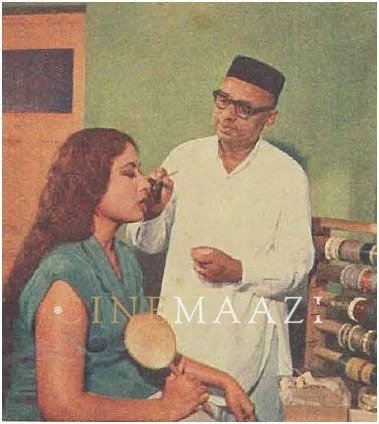
It now fell to Mahajabeen and her younger sister Madhuri to become bread-winners and at the age of four Mahajabeen donned make-up and costume for her first film role, which she played at the Prakash Studios with Vijay Bhatt directing her. At the end of the day she received twenty-five rupees.
Today the thought of it makes her happy that at the tender age of four she was the family's main support, auspiciously christened Meena Kumari for the screen by Director Vijay Bhatt. But she grew up with a sense of responsibility and in an atmosphere of sadness. Her only solace was refuge in a world of fantasy and dreams her work in films afforded.
Gradually the family's circumstances improved and their departure from a small flat in Dadar to their own bungalow, named Iqbal after her mother, was final evidence that they had left hard times behind. The house and garden rang again with the laughter of children, Meena Kumari herself leading the happy brigade.
Then came the day when the house was plunged in gloom for Iqbal, her mother, passed away. But, however crushing a tragedy, one must take up the thread of one's life again, and as time passed Meena Kumari recovered from the grief of her mother's death.
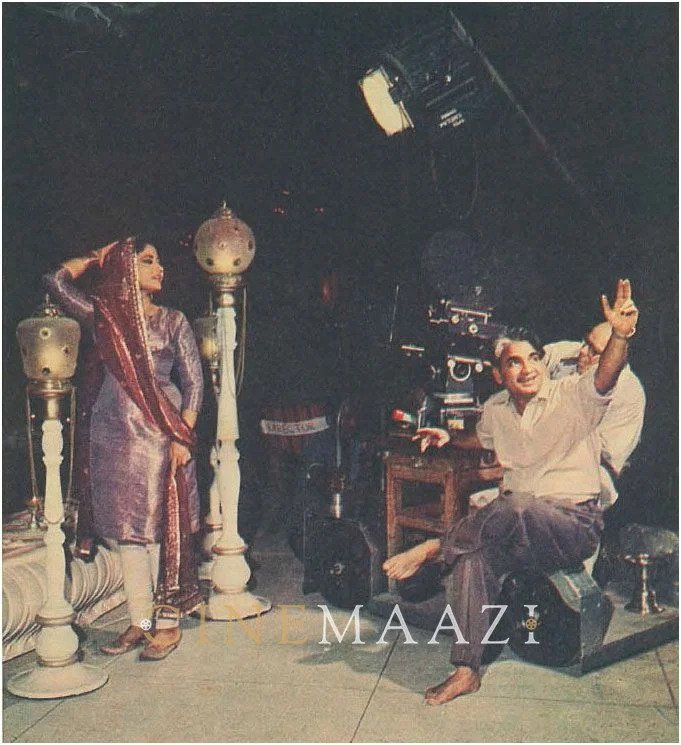
As a child artiste Meena Kumari worked in a number of films and grew up into a young woman of beauty. Yet the sunshine of her bubbling youth was tinged with the shadows of her sad past. That was in 1952, when she made her debut as a leading lady in "Madhosh."
Since then, in film after film, hers has been a paradoxical personality, an enigma which is a mixture of joy and sorrow, gaiety and gloom, optimistic determination and fatalistic pessimism. Her deep voice is ponderous and her diction, charged with emotion, is slow. Her movements are graceful, yet languorous. Her long, well-nursed shining hair, perhaps the longest in filmdom, frames her face in some sort of mystery. The impression her personality makes is that of a sad princess imprisoned within the magic casements of a tragic past. Her behaviour, attitude, hobbies, likes and dislikes, temperament and demeanour all point to a leisurely tempo of life. Hers is a life whose buoyance is suppressed and kept under control.
Yet everything she does has a charm of its own. She is generally happy in a deserted place, especially among ruins with some romantic legend behind them. For at such a spot Meena, the dreamer, imagines herself to be the subject of the legend—the ill-starred Roopmati, among the relics of Mandu, or Zebunissa in the corridors of Agra Fort. She avoids gay parties and big crowds. A picnic on a lonely river-bed, under the shadows of an ancient fort, is her idea of a good time.
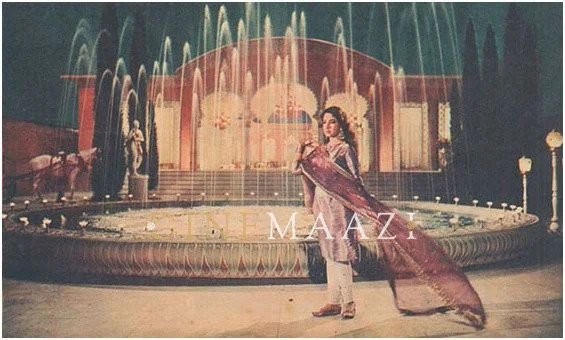
A goddess in early films, a princess in a few Arabian Nights fantasies, a singing-and-giggling heroine in several routine boy-meets-girl films, Meena Kumari found her metier when called upon to project her personality in a dramatic role in Vijay Bhatt's "Baiju Bawra". As the ill-fated Gauri of the film, Meena Kumari was an instant success and became the first actress to win "Filmfare's" coveted Best Actress Award. Followed "Parineeta," "Baadbaan," "Sharada," "Daera," "Dil Apna Aur Preet Parai," "Main Chup Rahungi," "Aarti" and "Sahib Bibi Aur Gulam," each offering a challenge and helping her to attain a great triumph. Her directors are unanimous in declaring, "Meena Kumari is an actress of enormous depth."
Vivacious And Jovial
This is Meena Kumari who warms the hearts of millions and whose countenance, according to common belief, carries the signature of pain. But few know of the impish, vivacious, jovial Meena Kumari. On the screen you will never see her dancing in the rain. But given a chance and left to herself, she will do just that. She is bright, forthright and candid. She has an exquisite sense of humour, too. When someone begins to tell her a joke, she says, "I am a good Muslim. I am not supposed to listen. What is it?"
The Indian screen, however, insists on typing Meena Kumari as a serious-minded tragedienne—the ideal Indian woman, the picture of suffering and self-sacrifice. In film after film she is this and nothing else, although her "Illzam," "Azaad" and, more recently, "Kohinoor" have proved convincingly that she can be an ebullient comedienne. Isn't Meena Kumari herself to be blamed for this state of affairs? Why must she always do what others ask her to do? She is an artiste and, as a true artiste, she must rebel against the limitations that imprison her art. She must not merely be a typical good woman. She must come out of her shell and become on the screen the complete woman she is in life. Let us hope that day is not far off.
This article was published in 'Filmfare' magazine's 21 September 1962 edition.
The images and captions are from the orginal article.
About the Author

.jpg)