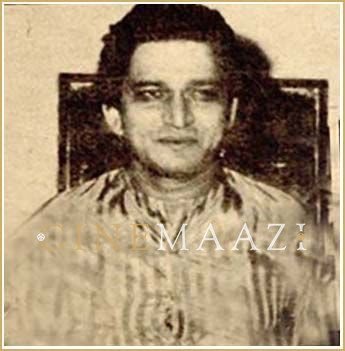

The Animated Cartoon Film in India by Kantilal Rathod
Subscribe to read full article
This section is for paid subscribers only. Our subscription is only $37/- for one full year.
You get unlimited access to all paid section and features on the website with this subscription.
Not ready for a full subscription?
You can access this article for $2, and have it saved to your account for one year.
In India, the [sic] film as an art form has rarely come up to the level of our traditional graphic, literary and dramatic arts in expressing human emotions and probing the depths of the human mind.
We have achieved maturity in the various arts, especially in the graphic art, and it is surprising that we have not made any conscientious effort to utilize this maturity in films, A direct form of the graphic art is the animated cartoon film which has a most fascinating technique, but we have failed to adopt it to any appreciable extent. Ever since we started making films in India about fifty years ago, we have been producing only “live-action” films. But our complete reliance on “live-action” bespeaks a brankruptcy [sic] of new ideas and a lack of courage to experiment in new forms, so essential for any art to remain fresh, alive and interesting.
What is the technique of the “animated” film in which the artist’s drawings are brought to life? To grasp this, we must know the first principles of motion-pictures. An art form, no matter how fantastic it may seem, is not magic, it is a blend of craftsmanship and imagination, based on aesthetic and scientific principles.
The animated film, like the live-action film is based on the principle of “persistence of vision.” The eye—the retina, to be extract—holds an image for 1/10th of a second after the object has passed from sight. This is called "persistence of vision." How does it apply to the motion-picture?
A strip of motion-picture film consisting of 1440 still photographs, called "frames," takes a screening time of one minute when projected at a speed of 24 frames per second. Each still photo, or frame, is exposed and projected on the screen at a speed of 1/24th of a second. Thanks to its ability to hold an image for 1/10th of a second, the retina sees all the separate images on the screen in a continuous flow.
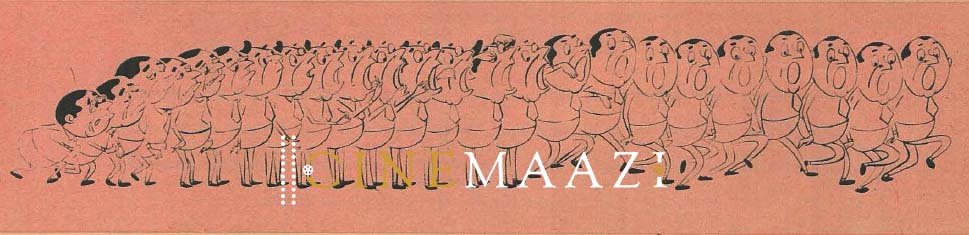
In a live-action film, there are still photos of live objects, whereas the animated film consists of photos of drawings. The artist prepares hundreds of drawings in desired actions and order. For instance, if he wants to show a man sneezing for one second, he makes 24 drawings and photographs them in order. When projected on the screen at the rate of 24 frames per second, the desired action takes place. The artist-animator plays the tune and the inanimate drawings dance to it.
It is interesting to note that as early as the 1880's, when the very first films were being made by the Melies brothers in France and Edison in the U.S.A., men like Emile Reynaud and Emile Cohl in France produced hand-drawn cartoon films which immediately became great successes. Today their names are all but forgotten, but their pioneering efforts have produced remarkable results.
Some of the prominent names in the field of animated films in Europe and America are: Winsor McCay, Walt Disney and the United Producers of America (U.S.A.); Norman McLaren (Canada); Len Lye, and Halas and Bachelor (England); Robert Wiene (Germany) and Trnka (Czechoslovakia). Their films have made us laugh with their comic episodes, cry at tragic events, wonder at the world of natural beauty and made us conscious of political and social problems.
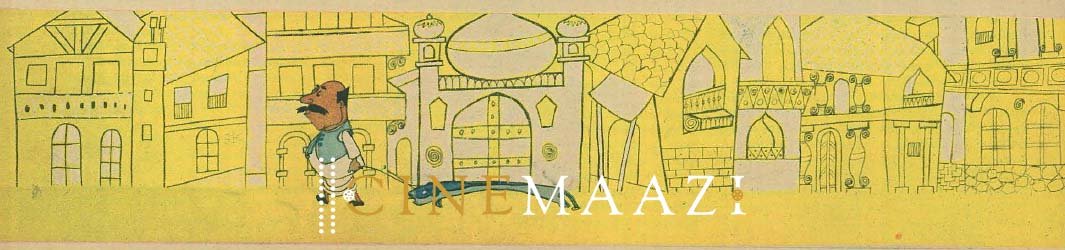
Although humour is the key-note of most of the animated cartoon films, their creators have also successfully tackled and depicted complex subjects and emotions. Apart from being a medium of entertainment, the animated film has also been effectively used for educational and advertising purposes.
But this wonderful form of film has been sadly neglected, particularly in India, by the makers of entertainment films. We are the third largest film-producing country in the world, and this is no mean achievement, quantitatively. But we have not accepted the animated film. There seem to be two reasons for this. Firstly, lack of finance coupled with scant interest and faith in the film as an art. To us film-making has always meant a business undertaking. The live-action films have a market, so why bother about the other form, especially when it is so different and troublesome! Besides, the entertainment-hungry millions of India enjoy any motion picture thrust upon them.
Secondly, the situation would have been different if our graphic art had been creative, but it has not been so in the last one hundred years at least. It is only since Independence that a mild form of revolution has taken place, and our artists have become sensitive to creative work. This has influenced the various fields related to the graphic art, and the animated film is certainly one of them.
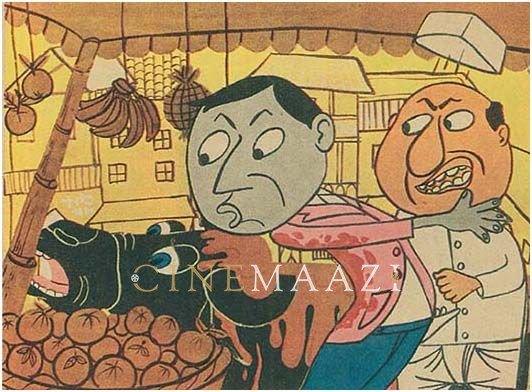
It would be incorrect to say that prior to Independence no attempts were made to produce animated cartoon films. "Lafanga Langoor" (1935) is considered to be the first Indian cartoon film. It was produced by Bodo Gutschwagner. About that time the Prabhat Talkies, of Poona, also made an attempt, though an unsuccessful one.
In 1942, a Cartoon Film Unit was set up by the Ministry of Information and Broadcasting under the guidance of Mr. and Mrs. Geoffery Johnson. They made an information film called "Malaria Control." The unit was disbanded two years later, but in the meantime it trained a batch of cartoonists and animators like P. N. Sarma, Wagulkar, Zakaria, Gupte and Gokhale. Some of them have since been working for documentary and advertising films.
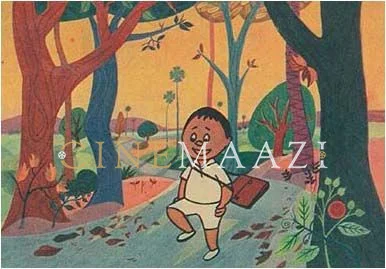
In 1948, the Indian Cartoon Pictures made "Ek Sadi Ke Baad" in Bombay. In Madras, Gemini Films launched a similar project but did not complete it. These films were of little artistic consequence. The human characters in them were either crude or "un-Indian." Still a beginning had been made. While the makers of entertainment films and, to a certain extent, documentary film producers did not patronise animated films, some of the leading national advertisers continued to give a fair amount of support.
In the mid nineteen-fifties, the Films Division of the Ministry of Information and Broadcasting formed a Cartoon Film Unit. Clair Weeks of the Walt Disney Studio was commissioned to set it up and train the staff. Two young members of the staff, animation directors Ahmed Latif and Suraiya, made fine contributions. Then last year, Pramod Pati, returning after two years' intensive training in puppet film-making in Czechoslovakia, took charge of the unit. The unit employs about "30 artists and turns out some excellent films and diagrammatic animation for its documentary films.
On my return from the U.S.A. after studying painting and films and undergoing practical training, I set up in 1957 an animation film unit for a documentary film producer in Bombay. Under my direction nearly 50 short films (advertising and documentary) have been produced. Thus, in the last five years more animation work has been done than ever before. The usefulness and effectiveness of animated films have been acknowledged by the Central and State Governments as well as by commercial firms. But this medium has yet to be accepted by the makers of entertainment films.
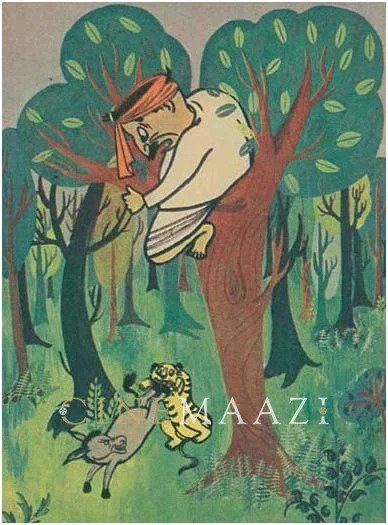
Unless the animated film gets the support of feature film producers, its potentialities cannot be realised to the fullest extent. If pure entertainment is to be provided to the millions of cinemagoers every day, the animated film must also be exploited.
The language of the animated film (cartoon or otherwise) is understood by all —from very young children to jitter-bugging juveniles, from mature adults to old people bent with age. Intellectually, the viewers could be poles apart—from morons to scholars.
It would be a pity if the financiers of feature films continue to ignore the making of animated films on mere grounds of profits. Even financially, the animated film could be an attractive proposition. Consider what a star-studded feature film costs. An animated film could be made for half the amount.
There is an immediate need for children's films (which could also be enjoyed by adults) based on stories which would make them laugh or make them wonder at pew ideas, inspire them to be brave, bring them closer to their fellow human beings. Here the possibilities are limitless for the animated film. The worlds of fantasy and fact can be poetically and imaginatively created by the artists in animated films in a manner the live-action technique is incapable of achieving. This is not to say that live-action is inferior to animation. They are different techniques and perform different functions. So there should be no fear that the animated film will deal a death blow to the live-action film.
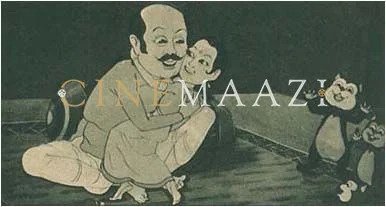
While the support of the feature film producers is necessary for developing this deserving technique in India, the animation film makers must also play an important role. Technically and aesthetically, they must gain further knowledge through experimentation so that they may stand on an equal footing with other film makers in the world. They must also draw inspiration from traditional Indian paintings, because the styles of some of the schools of painting have a resemblance to those of animation drawings. The richness of colour, the boldness of line, the imagery created through form, should offer the makers of animated films enough scope to develop a style different to the modes popular at present in western countries.
Other arts, literature and folk lore of India are also sources of inspiration. Music, dance, folk tales, epic poetry and humorous stories, appropriately translated to the visual form of the animated film, would exhilarate and elevate us.
This article was published in 'Filmfare' magazine's 15 December 1961 edition.
The images and captions are from the orginal article.
About the Author