




This section is for paid subscribers only. Our subscription is only $3700/- for one full year.
You get unlimited access to all paid section and features on the website with this subscription.
On This Day
Choose a Date
Search Cinemaazi
Select your cinema
- All
- हिंदी (Hindi)
- भोजपुरी (Bhojpuri)
- தமிழ் (Tamil)
- ગુજરાતી (Gujarati)
- অসমিয়া (Assamese)
- ਪੰਜਾਬੀ (Punjabi)
- मराठी (Marathi)
- తెలుగు (Telugu)
- বাংলা (Bengali)
- سنڌي (Sindhi)
- ಕನ್ನಡ (Kannada)
- پارسی (Parsi)
- कोंकणी (Konkani)
- മലയാളം (Malayalam)
- English (English)
- Others (Others)
- Silent (Silent)
- संस्कृत (Sanskrit)
- नेपाली (Nepali)
- ଓଡିଆ (Odia)
Subscribe to read full article
This section is for paid subscribers only. Our subscription is only $37/- for one full year.
You get unlimited access to all paid section and features on the website with this subscription.
Not ready for a full subscription?
You can access this article for $2, and have it saved to your account for one year.
- Release Date1953
- LanguageHindi
218 views
Indrani, now a widow, arrives in her country house, in the village, Tantihat. Here she has a fairly big estate which is looked after from the city by Haritosh Babu, a friend of her husband.
Ashok, son of Haritosh Babu, is intimately known to the members of Indrani's family which presently mean, her daughter Sheela and her youngest son Anand.
She recently lost her eldest son Mukul and it is more for peace of mind and a change of environment than for conducting the business of her estate that she has come over to her village home.
In Tantihat, she has Bhavataran, as her local manager and the estate is run, on the old Zamindary lines, which is a queer mixture of power, threat and nobility.
Presently, the village is passing through some excitement on account of the activities of one Nirmal, who was once a well-known terrorist but now a social worker on peaceful and constructive lines. To him, the foremost need of Independent India, is the upliftment of villages through education and self-help.
He has started, in this village, a school on a very novel idea. Children here study through games and other forms of recreation. They are not to pay any fee, but they have to devote certain hours for spinning, weaving and farming, so that they can meet their own expenses for education.
Boys of this school are happy and gay. Unquestionably One finds here a complete absence of that stiff and suffocating atmosphere, Which may be found in a High School. As Nirmal's technique of imparting education, did include neither hard and fast routine for studies nor punishment, his school has become very popular. Boys deserted other schools to join his.
For instance, there is a Pathashala in this village where the attendance has grown very thin. This school is maintained from the income of Indrani's estate and Pandit is the only teacher there.
Nirmal's popularity is extremely disliked by Bhavataran in a way, his frequent conflict with Nirmal symbolises the clash between the old and the new. He has been described as a 'dangerous' element to Indrani, both by the shrewd and vindictive Bhavataran as well as by Pandit who is simple and amusingly conservative.
This year the Saraswati Puja is being performed with much pomp and splendour in Pandit's Pathashala, and here Indrani comes to know all about Nirmal's school. She is a lady of a kind disposition but still Bhavataran succeeds in prejudicing her against Nirmal.
The actual clash comes in with the advent of the boy Mohan in Indrani's life. He is one of the artistes in a touring theatrical party, now engaged here for the Puja festival. The manager of this company is a bully and a miser, and Mohan develops in his mind a childish ambition that some day he will leave this party and start his own. He has many lovable qualities, but he is definitely a straggler as most boys in such theatrical associations are. They are not at all well recompensed for the services they render. Ill-fed and ill-clothed, they take to all sorts of vices to keep them going on. Mohan smokes; Mohan steals.
One noon, Mohan is caught while stealing some fruits from the garden adjacent to Indrani's house. In his attempt to escape, he hits Sheela but when he is produced before Indrani, the latter surprisingly becomes very tender on him.
There is a striking resemblance between Mohan and her lost son, Mukul, who suddenly fills her mind.
Indrani takes him inside the house, serves him with sumptuous food and finally orders him to take rest on a comfortable bed. She assures Mohan that she will see to all his needs. Mohan finds in this assurance a possibility of the fulfilment of his long-cherished dream that he will own his own theatrical company.
Mohan leaves the theatrical party and comes to stay in Indrani's house but now to his utter dismay he finds that Indrani is making arrangements for his education.
He has to join the Pathashala with her son Anand. Pandit's effort to acquaint Mohan with the alphabet leads to a series of pathetic and amusing scenes.
Unable to bear any more tortures of schooling, he one day runs away from the house and takes shelter in a place where again to his chagrin, another school is being held. But here he notices a method of teaching, which gradually removes from his mind the fear he has about that object known as 'book'.
He gets eager to learn the alphabets. And indeed in a short time he learns to read. Mohan can read now. This happens in Nirmal's school.
This is a defeat for Indrani because this is a defeat of the system in which her Pathashala is run.
She comes to visit Nirmal's school. Nirmal welcomes her, and explains to her the method of teaching. She returns, highly impressed by the whole thing that she saw there. But instead of helping Nirmal, she declares her intention of starting another school on an even better scale.
Rivalry is one of the main ingredients on which old nobility thrives. Bhavataran announces by beat of drum and other devices, of the school proposed to be opened by Indrani. In this matter, Indrani seeks the help of her friend, Shrimati Hansa Kumari, a lady graduate from a foreign university.
Hansa Kumari comes to the village, but to her shocking disappointment, she finds in Pandit, - a teacher unfit for teaching. Pandit has been teaching the children that the sun moves round the earth because he has seen so with his own eyes!
How this new development complicates matters and how Nirmal's teaching methods are vindicated is best seen on a screen in a series of incidents that lead to a thrilling climax.
[From the official press booklet]
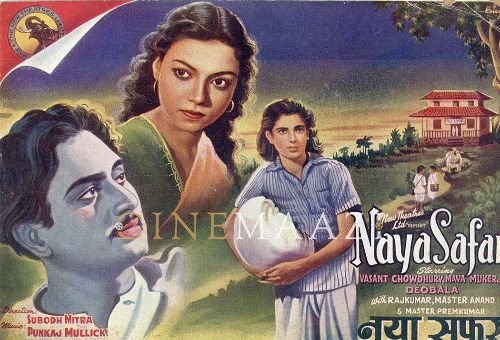
Cast
-

Prem Kumar
Mohan -

Devbala
Indrani Devi -
Molina
Hansa Kumari -
Maya Mukherjee
Sheela -
Rekha Chaterjee
Sahankar Bala -
Vasant Chowdhury
Nirmal -
Rajkumar
Ashok -
Tulsi Chakraborty
Balwant -
Pt. Natwar
Bhavatrarani -
Hari Shankar
Hari Bhaiya -
J Kumar
Pandit -
Parijat Bose
Bhim -
K C Sharma
School Teacher -
Naresh Bose
School Teacher -
Sheriff
Laxman -
Hiralal
Sitaram
Crew
-
BannerNew Theatres, Calcutta
-
Director
-
Producer
-
Music Director
-
Lyricist
-
Cinematography
-
Editing
-
Costumes
-
Make-up
-
Art Direction