
Ask any film maker (who knows the ropes and the bank balance, too!) the secret of a successful movie. “Script’s the thing,” he will tell you. And how very right he is. After all, a medium involving vast sums of money can hardly be left to mere chance, on-the-spot improvisation or last-minute inspiration.
In the days of Agha Hashr Kashmiri and Pandit Betab, writers used to insist that directors should conform to the script (which was actually a copy of their stage-play being enacted somewhere) to the very letter. Not a word could be moved from its place—although words did move in those days. And there were producers who were sticklers for realism, long before Rossellini and de Sica learnt to spell the word, and they clung to the written word like burr.
The story goes of a Bombay producer who got the bright idea of loading his heroine with the heavy, solid gold ornaments of his wife.
"It is not necessary, Sethji," pleaded the director.
"No," roared the Seth. "'Gold', it says in the script, and gold it is going to be."
For days together, the frail little heroine carried her slender neck with a sprain caused by the sethani's solid gold ornaments.
There is another one of a Calcutta producer who sent his production manager to buy a sari costing a thousand rupees, because the script said so. The production manager combed the entire city, but could find no sari worth more than a few hundred. It was an affront for the Seth to present his heroine in a sasta sari, and a matter of principle to stick to the script.
He ordered the production manager to tack currency notes all over the sari!
It must, indeed, have been a fascinating wear for the actress but, so far as I know, the fashion has since gone out of vogue.
A veteran film maker was once confronted with the problem of dealing with a temperamental heroine. She refused to come to the shooting in the final stages of the film. The producer was completely upset, understandably. The resourceful director, however, "turned" the heroine into a parrot, shot the rest of the film featuring the bird and—what is more—made a success of it.
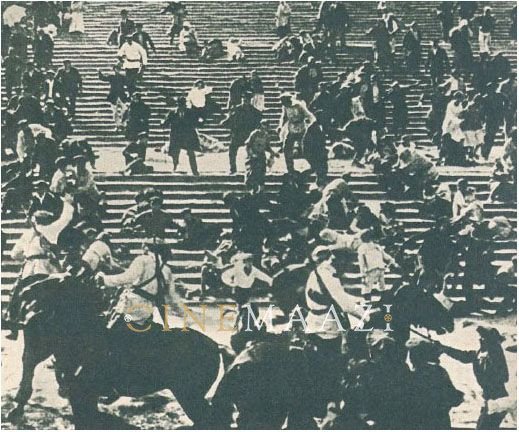
To turn from the ordinary to the extraordinary, some of the most celebrated moments on the screen have been the result of discovery made on the spur of the moment. What has come to be known as the greatest single sequence in screen history was created this way. It occurs in Eisenstein's, masterpiece “Battleship Potemkin."
The film tells of a mutiny on the cruiser "Potemkin," in 1905, when the crew hoisted the red flag of revolution because of the insufferable conditions on the ship-rotten meat that is given to the crew. To convey this, the screen is filled with putrefaction-worms swarming in a vast, grey expanse.
Here we see the very essense of Eisenstein's method, with its two phases of calm separated by frenzy and movement. A sailor has been killed, his body is carried to Odessa, the news spreads like wild fire. The militia enters the scene and fires on the crowd. According to historians Bardeche and Brasillach, there are few scenes more famous in the whole history of the film than this one.
Down the great flight of steps in Odessa men and women flee; a crowd in confusion screams; a perambulator goes bumping by; pitiful groups hold out imploring hands. Slowly, mechanically, inexorably, the soldiers advance towards them; the measured pace, the rigid line, this terrifying mechanism of misfortune interrupts the inorganic disorder of flight. Nothing can withstand this fatal advance, this regular march, this rectilinear flight of steps.
.jpg)
And yet, according to Eisenstein, "Neither the original script nor the montage drafts provided for the shooting scene on the Odessa steps. The idea flashed in my mind when I saw the steps."
Another instance of inspiration of the moment in the same film was the famous "fog sequence". Let Eisenstein himself describe it: "A heavy mist hung over the port. A mist means a 'wasted day', a Black Friday in the shooting schedule... Here and there, the fluffed lint of a fog was pierced by a few threads of sun-rays imparting to it a warm, golden tint... All that was very good, but work was out of the question. We hired a boat for 3.50 rubles.
"Tisse (cameraman), Alexandrov (assistant director) and I went boating in the misty harbour which looked as if it were covered with apple blossoms.
"Three men in a boat… Our camera, like a faithful dog, was with us. And, like ourselves, it was hoping for a rest. But the three men were enthusiastic and it had to work, photographing the mist. The mist stuck to the lens of the camera like wool sticks between teeth... The chance encounter with mists suddenly acquired an emotional content, the choice of details, the individual shots were combined at once into plastic mournful chords, to produce later, in the process of montage, a funeral symphony in memory of Vakulinchuk (the dead sailor).
"This scene was the least expensive in the picture. It cost only 3.50 rubles which we paid for the hire of the boat."
In Satyajit Ray's film "Aparajito" one of the most beautiful scenes is where Apu is given a little money and he feels the urge to visit the monkeys in the Durga Temple. He feeds them with peanuts. The monkeys swing from bell-ropes, hop, grimace and caricature him; they scream and make shrill noises. Obviously comic, yet a more subtle and deeper symbolism is created.
This scene was not in the original script but was inspired by a visit to the Durga Temple.
Records Satyajit Ray, "Visited the Durga Temple. People who come here with the intention of offering prayer. to the deity usually do so with half a mind, the other half being on the monkeys. These animals go about the place as if they owned it… But when they swing from the bell-ropes and perform an impromptu carillon, the sight and sound are no longer merely comic. Rich possibility for a scene with Apu."
Then, the opening shots of "Aparajito,'' pigeons taking flight from their perch on the cornices and making enormous circular sweeps in the sky, also were not in the script.
Directing "Dharti Ke Lal," K. A. Abbas was on location to shoot the famous hunger march sequence, when suddenly he heard that a boat laden with grain was proceeding towards a village. This was a unique opportunity for Abbas to show the cause and the effect—the hoarding and the hunger. He persuaded the boatmen to participate in the sequence.
As an unending line of bent, broken and famished men and skeletons of women pass in front of the camera, from behind emerges the hoarder with his boat full of grain. The scene was thus invested with a demonic, explosive quality.
In "Anhonee," another film of Abbas, the unusual climactic sequence was planned on the spot. Nargis, the "bad girl" in the film (she played a double role), discovers the portrait of her dead father in the attic where a strange assortment of furniture, stuffed animals, shikar trophies and many other odds and ends are stored. Suddenly filled with revulsion, she shoots at the portrait.
What would have certainly ended, as a routine scene was saved from that fate by Nargis's absence. Abbas hit upon the idea of giving it a subjective treatment, using the obliquely-placed props as viewed by a mad woman—the menacing stuffed animals, the ancient kerosene-oil lamp throwing fantastic, weird shadows, the Dorian Grayish portrait of the father. All this imparted a claustrophobic intensity to the scene.
There are innumerable other instances where remarkable results were achieved with last-minute improvisation or inspiration. Indeed, one wonders what the films of de Sica, Rossellini, Fellini, Ray and Robert Flaherty would have looked like, had they always stuck to the neatly-typed, leather-bound scripts.
Much of the vitality, freshness and spontaneity of their work were not only hard to pre-determine or pre-plan, but also the result of a direct and immediate response to people and events around them. Yet, somehow, I do not completely disagree with the successful movie maker who said: "Script's the thing."
This article was published in 'Filmfare' magazine's 6 November 1959 edition.
The images and captions are from the original article.
About the Author